
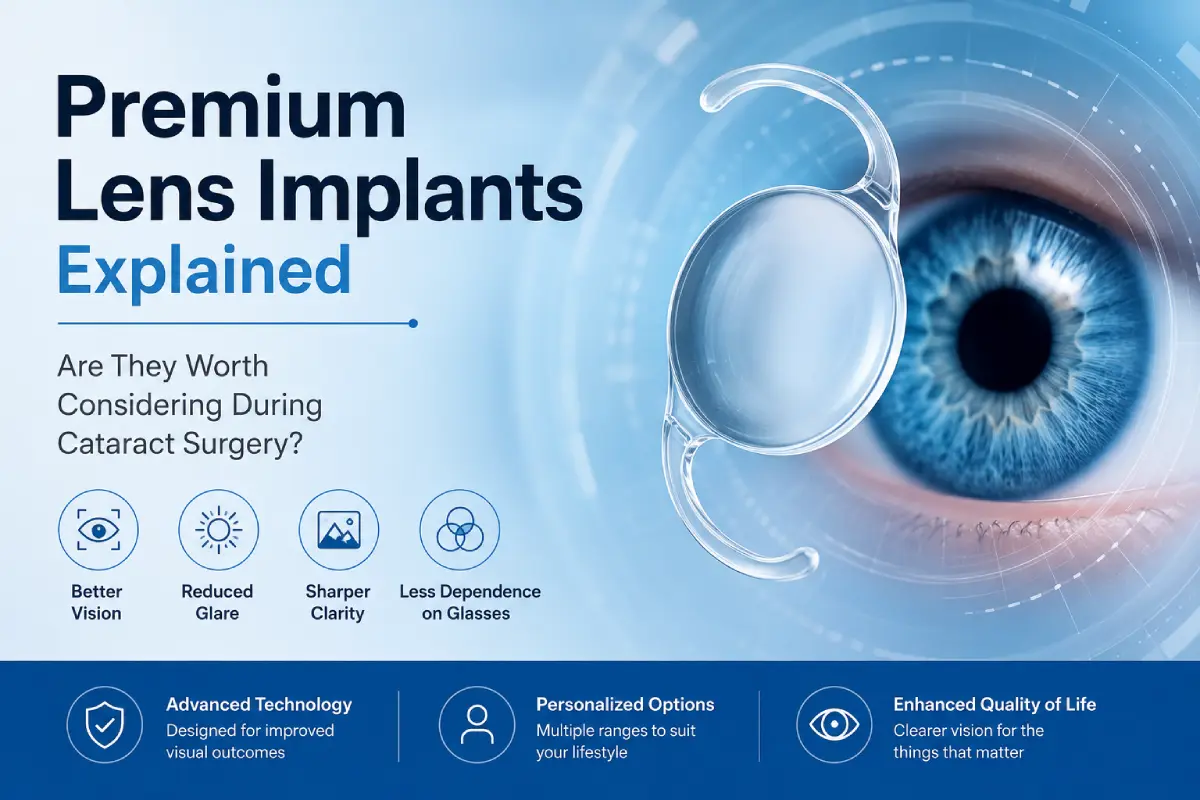
Premium Lens Implants Explained – Cataract surgery is one of the few operations where the patient makes a real decision about the result. The procedure itself is highly standardized. The surgeon removes the clouded natural lens and replaces it with an artificial intraocular lens, or IOL, in a process that averages ten to fifteen minutes per eye. The part that varies, and the part that determines how you see for the rest of your life, is which lens goes in.
That choice happens once. The implant stays in the eye permanently, so it is worth understanding the options before the consultation rather than during it.
Table of Contents
What the standard lens actually does
Monofocal IOLs come standard with cataract surgery and are covered by insurance. Several manufacturers make them and the quality is comparable across brands. The limitation is in the name. A monofocal lens focuses at one distance, and you pick which one: far, intermediate, or near.
Most patients choose distance, which handles driving, television, and moving through the world without correction. Reading glasses then become part of daily life. For many people that is the right outcome. It removes the cataract, restores clarity, and costs nothing beyond the covered procedure.
Where premium lenses change the equation
Presbyopia-correcting IOLs are built to provide functional vision at two or three ranges at once. Patients who receive them often need no glasses for distance and intermediate work, and depending on the lens, none for reading either.
The category is not uniform. Trifocal designs such as the PanOptix cover near, intermediate, and distance. Extended depth of focus lenses like the Symfony stretch a continuous range rather than splitting it into discrete focal points. Accommodative lenses such as the Crystalens work differently again, providing distance and intermediate vision with a narrower near range, meaning readers may still be needed for fine print. That lens has an advantage worth knowing about: it does not produce the halo and glare effects that some multifocal designs can cause at night.
Astigmatism is a separate axis of the decision. Correcting it requires a toric lens. Some monofocals are available in toric versions, as are the leading premium IOLs, so astigmatism does not lock you out of any particular tier.
Newer light adjustable lenses add a further option, allowing the power of the implant to be fine-tuned with ultraviolet light treatments after the eye has healed, which shifts part of the decision from before surgery to after it.
The honest trade-offs
Premium lenses are not automatically better. They are a different set of compromises.
Multifocal designs split light between focal points, which can reduce contrast sensitivity and produce halos or starbursts around lights at night. Most patients neuroadapt over weeks to months. Some do not, and a small number find it genuinely bothersome.
More importantly, certain eye conditions make these lenses a poor fit. Diabetic retinopathy and macular degeneration can make multifocal implants contraindicated, because those conditions already compromise the retinal quality the lens design depends on. This is not a marginal detail. It is the reason a thorough preoperative evaluation matters more than the brochure.
The cost question, framed properly
Insurance covers monofocal implants. It generally does not cover toric, multifocal, or accommodative lenses, which means the upgrade is an out of pocket decision.
The comparison people rarely make is against the alternative. A pair of prescription glasses runs somewhere between $300 and $1,000, and most people replace them every few years for the rest of their lives. A premium implant is a single expense for a device meant to last permanently. Whether that math works depends on your prescription, your age, and how much you value being glasses free, but it is the right calculation to run.
Where LASIK sits in this
Cataracts and refractive error are related but separate problems. If you are under forty with no lens clouding, corneal surgery is the conversation to have, and in Los Angeles, LASIK surgery can correct nearsightedness, farsightedness, and astigmatism in a procedure lasting fifteen to twenty minutes for both eyes. If you have already had LASIK and are now developing cataracts, mention it early. Prior corneal reshaping changes how IOL power is calculated, and surgeons account for it with specific formulas.
Getting a real recommendation
The right lens depends on your corneal measurements, your retinal health, your pupil size, and what you actually do all day. Review the full range of cataract surgery lens options before your visit, then bring your questions to a trusted eye doctor who will walk through the contraindications rather than the marketing. Eduardo Besser MD cataract surgeon practices in Culver City and performs refractive cataract surgery, laser vision correction, and advanced IOL implantation. Call the office or book a consultation online to find out which lens fits your eyes.