
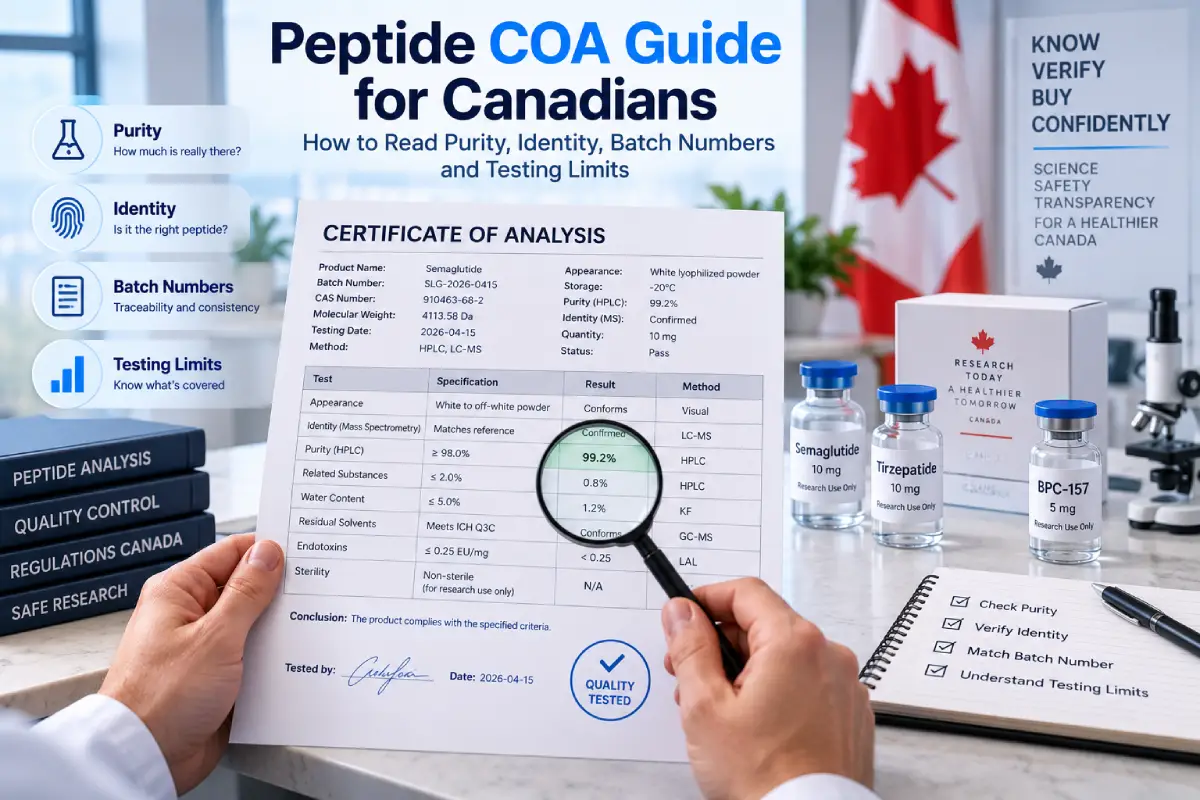
Peptide COA Guide for Canadians: How to Read Purity, Identity, Batch Numbers and Testing Limits
A peptide certificate of analysis can look authoritative at a glance: laboratory name, numerical results, technical terminology and a formal report layout. The value of the document, however, depends on a much simpler question – what exactly was tested, and what conclusion does that test support?
For Canadian readers comparing peptide vendors, learning to read the report itself is more useful than treating “third-party tested” as a universal quality badge. Different tests answer different questions, and even a genuine report has limits.
Table of Contents
The short answer: a COA is evidence about a sample, not everything around it
A useful COA should identify the sample, test method, result, laboratory and date. Ideally, the vendor also explains how the report connects to the batch or listing being sold. The report may help evaluate a technical claim about the submitted sample, but it does not automatically establish authorization, medical suitability, shipping quality or the contents of every future vial.
What should a peptide COA contain?
Start with identification before interpreting the number. Look for the laboratory name, report number, sample description, test date, method, units and result. If the vendor publishes a tiny screenshot, find the full report before drawing conclusions. Cropped images can omit qualifiers, sample details or additional test results that change the meaning of the visible number.
If the issuing laboratory provides a report-authentication tool, use it. Authentication can help confirm that the document corresponds to a laboratory record. It still does not tell you who selected the sample, how it was handled before testing or whether a later item comes from the same material.
Purity and identity are not the same question
One of the most common mistakes is treating every percentage as if it means the same thing. Identity testing asks what substance was detected. Purity analysis asks about the composition of the tested material according to a particular method. Fill or content testing asks how much material was measured. Endotoxin testing addresses another quality dimension. Sterility is yet another question.
A report showing one type of test should not be summarized as “fully tested” unless the vendor clearly defines what that phrase means. Better wording names the actual test: identity reported, purity reported, fill amount measured, endotoxin result available, and so on.
Batch numbers matter because the connection matters
After reading the laboratory report, look at the vendor listing. Does the product page show a batch or lot identifier? Does it match the report? Is there an explanation when the labels differ? A shared product name creates a weaker connection than a documented batch match.
Even a matching batch label does not answer every chain-of-custody question. The report concerns the sample submitted to the laboratory. The vendor is responsible for explaining why that sample represents the item being offered. Readers should distinguish the laboratory finding from the seller’s representation linking the finding to inventory.
Use comparison sites to locate evidence, not replace it
Canadian readers can use Peptide Index to organize vendor information and locate publicly available testing, shipping, pricing and transparency details. A comparison table is most useful as a navigation layer: once a testing reference is found, open the original report and read the identifiers, methods and limitations yourself.
This approach also makes comparisons fairer. One vendor may publish extensive purity results but limited endotoxin information. Another may publish fewer reports but make batch matching much clearer. A single “testing available” checkbox cannot capture that difference unless the methodology behind the comparison explains what the field means.
Why promotional evidence belongs in a different category
A lab report and a promotional record can both be “verified” without verifying the same thing. A laboratory report concerns a sample. A discount-code record concerns a checkout observation. Mixing the two creates confusion because a successful promotion says nothing about the technical quality or authorization of a health product.
The VIP10 verification record is an example of promotion-specific documentation. Its role is to document checkout observations and their conditions. It should not be read as a laboratory or medical assessment, just as a peptide COA should not be treated as evidence that a discount code is current.
How to spot weak or incomplete testing presentation
• Only a cropped screenshot is shown and the full report cannot be located.
• The report is undated or the sample description is too vague to connect to a listing.
• A product page uses “tested” without identifying which tests were performed.
• A single purity percentage is used to imply identity, fill amount, sterility and safety at the same time.
• The vendor does not explain how a report connects to its batch or inventory.
• Old reports are displayed without making the test date visible.
• Marketing language is more prominent than the underlying technical document.
A seven-step peptide COA reading method
1. Identify the laboratory and report number.
2. Record the sample description and test date.
3. Identify each test method separately.
4. Read the units and result exactly as reported.
5. Check whether the laboratory record can be authenticated.
6. Compare the report identifiers with the vendor’s batch or listing.
7. Write down what the report does not establish.
Frequently asked questions
What does 99% purity mean on a peptide COA?
It means the report produced a purity-related result under the method described by the laboratory. The exact interpretation depends on the method, sample and report details. It does not automatically establish identity, fill amount, sterility, safety or Health Canada authorization.
Can a COA be real but still not prove the vendor’s whole inventory?
Yes. Authentication can confirm that the report is a real laboratory record, while the connection between the submitted sample and the vendor’s wider inventory remains a separate question.
Should older peptide COAs be ignored?
Not automatically. Older reports can provide historical information, but readers should not treat them as evidence about a newer batch unless the vendor documents that connection. Dates should remain visible so readers can distinguish historical testing from current inventory.
Canadian regulatory context still applies
Health Canada has warned consumers about unauthorized injectable peptide drugs sold online. A vendor-posted laboratory report is not a substitute for authorization or medical guidance. When the question is whether a drug is authorized in Canada, consult Health Canada sources and licensed healthcare professionals rather than attempting to infer authorization from technical testing alone.
Conclusion
The best way to read a peptide COA is to make the claim smaller, not larger. Identify the sample, method, result, date and vendor connection. Then stop where the evidence stops. That habit produces more accurate vendor research and makes it easier to distinguish genuine documentation from marketing shorthand.

Khizrana Begum is a health and wellness writer covering nutrition, fitness, healthy lifestyle, preventive health, mental wellness and everyday health topics.

Sameena Begum reviews health, fitness and wellness content for clarity, readability, consistency, factual presentation and reader usefulness.

Dr. Syed Imtiaz is an MBBS and MD qualified medical professional with 5+ years of experience in general medicine, dermatology, preventive healthcare and skin health.