
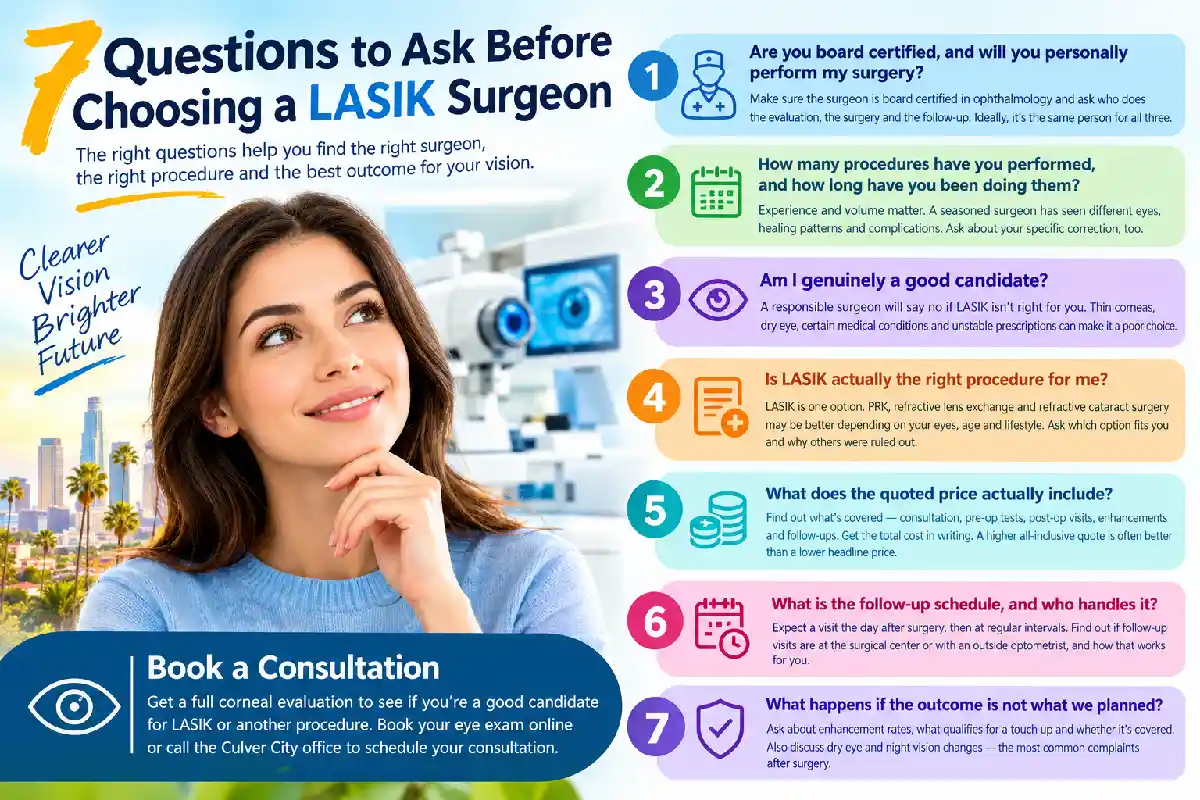
Choosing a LASIK Surgeon
Laser vision correction is one of the few elective procedures where the technology has become almost standardized, and yet outcomes still vary. The lasers used across reputable practices in a city like Los Angeles are broadly similar. What differs is the surgeon operating them, the screening process that decides whether you should have the procedure at all, and the care you get in the weeks after.
That makes choosing wisely less about comparing brochures and more about asking the right questions at a consultation. Here are seven worth bringing with you.
Table of Contents
1. Are you board certified, and will you personally perform my surgery?
This sounds basic. It is still the single most useful question, because some high volume centers rotate patients through whichever surgeon is available that day. Ask who does the pre-operative evaluation, who operates, and who sees you afterward. Ideally it is the same person for all three. Board certification in ophthalmology, plus membership in bodies like the American Academy of Ophthalmology or the American Society of Cataract and Refractive Surgery, tells you the surgeon is accountable to a professional standard.
2. How many procedures have you performed, and how long have you been doing them?
Volume matters in refractive surgery, but so does duration. A surgeon who has been operating for two decades has seen the unusual corneas, the healing patterns that do not follow the textbook, and the complications a newer surgeon has only read about. Ask about experience with your specific correction as well. Treating high astigmatism is not the same as treating mild nearsightedness.
3. Am I genuinelya good candidate?
The most reassuring answer a surgeon can give you is no. Thin corneas, unstable prescriptions, severe dry eye, and certain autoimmune conditions all make LASIK a poor choice. A practice that approves nearly everyone who walks in is telling you something about its priorities. Good lasik surgeons in Los Angeles that patients rely on will turn people away and explain exactly why.
4. Is LASIK actually the right procedure for me?
LASIK is the best known option, not the only one. PRK avoids creating a corneal flap and suits patients with thinner corneas or high impact jobs. Refractive lens exchange replaces the eye’s natural lens and often makes more sense for patients over fifty. If you are already developing cataracts, refractive cataract surgery can correct your vision and remove the cataract in one procedure, which is why many cataract surgeons in Los Angeles also perform laser vision correction. Ask which option fits your eyes and your age, and why the alternatives were ruled out.
5. What does the quoted price actually include?
Advertised per eye pricing frequently excludes the consultation, the pre-operative measurements, post-operative visits, and any enhancement procedure you might need later. Ask for the total cost in writing, including follow-up care for at least a year. A slightly higher all inclusive quote is often cheaper than the headline number once everything is added.
6. What is the follow-up schedule, and who handles it?
You should expect to be seen the day after surgery, then at intervals over the following months. Find out whether those visits happen at the surgical center or get handed off to an outside optometrist. Neither arrangement is automatically wrong, but you want to know before you commit, particularly if you would need to drive across the city for each appointment.
7. What happens if the outcome is not what we planned?
Ask directly about enhancement rates, what circumstances qualify for a touch up, and whether it is covered. Also ask about dry eye and night vision changes, which are the most common complaints after surgery. A surgeon who discusses these openly at the consultation is far more likely to handle them well if they occur.
Book a consultation
Dr. Eduardo Besser is a board certified ophthalmologist in Los Angeles and a founding physician of Angeles Eye Institute in Culver City. He performs LASIK, PRK, refractive lens exchange, and refractive cataract surgery. Consultations include a full corneal evaluation to determine whether you are a suitable candidate. Book an eye examination online or call the Culver City office to arrange yours.
Khizrana Begum is a health and wellness writer covering nutrition, fitness, healthy lifestyle, preventive health, mental wellness and everyday health topics.

Sameena Begum reviews health, fitness and wellness content for clarity, readability, consistency, factual presentation and reader usefulness.
Dr. Syed Imtiaz is an MBBS and MD qualified medical professional with 5+ years of experience in general medicine, dermatology, preventive healthcare and skin health.