
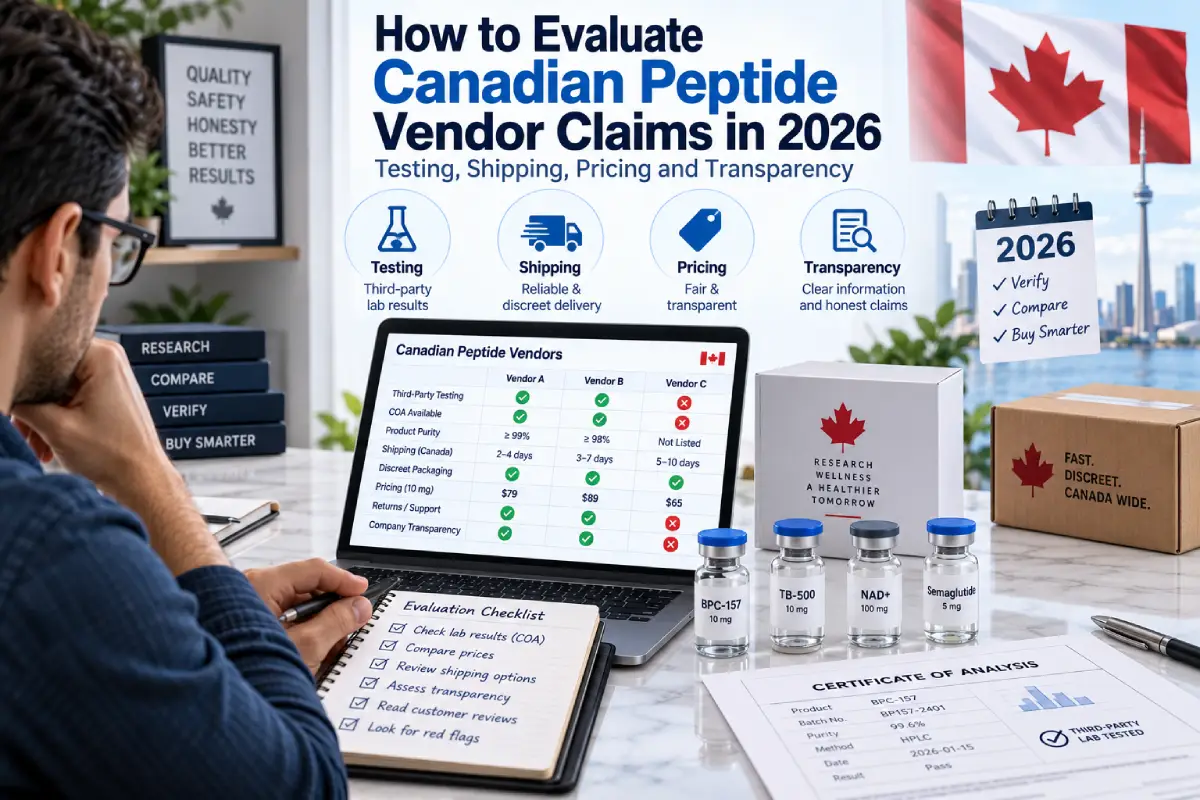
How to Evaluate Canadian Peptide Vendor Claims in 2026: Testing, Shipping, Pricing and Transparency
Please hyperlink those exact natural anchor phrases where they appear below.
Canadian peptide-vendor research can become confusing quickly because product pages, laboratory documents, shipping policies, discount offers and health claims often appear side by side. The most reliable way to read that information is to separate each question and ask what evidence actually supports it. A vendor can have a polished website and fast shipping information while still leaving important questions about testing, authorization or documentation unanswered.
For Canadian readers, this distinction matters even more because Health Canada has warned against unauthorized injectable peptide drugs sold online. Website research can help someone understand what a business publishes, how transparent its policies are and whether a promotional claim has recent evidence. It does not replace regulatory authorization or medical advice.
Table of Contents
The short answer: evaluate the evidence, not the presentation
A strong vendor-research process checks five separate areas: regulatory status, testing documentation, business transparency, shipping and payment information, and the freshness of promotional claims. None of those categories should be allowed to stand in for the others. A recent lab report does not prove shipping reliability; a successful delivery does not prove product quality; and a working discount code does not establish safety or authorization.
1. Start with Canadian authorization and the exact product
Before comparing vendors, identify what kind of product is actually being discussed. Health Canada assigns an eight-digit Drug Identification Number (DIN) to authorized drug products, and its Drug Product Database is a primary source for checking authorized medicines. A broad ingredient name or a “research use” label is not the same thing as an authorization record for a particular product, strength and dosage form.
This is why search results should be read carefully. A page may discuss a peptide in a research context, a medical context and a retail context without making those categories clear. If the question is medical or regulatory, use authoritative health sources and qualified professionals rather than relying on a vendor page or a coupon article.
2. Read peptide testing documents as documents, not badges
A certificate of analysis or laboratory report can be useful when it is readable, dated and connected to a specific sample or batch. Look for the issuing laboratory, report or task number, sample description, test method, result, date and any batch identifier shown by the vendor. When a laboratory offers its own report-verification system, use that source rather than relying only on a screenshot copied into a product page.
The next question is scope. A purity result answers a different question from identity testing, fill amount, sterility or endotoxin testing. One impressive number should not be converted into a broad conclusion about everything the vendor sells. A careful comparison records exactly what was tested and what remains unknown.
3. Compare vendors using a repeatable research framework
A comparison resource such as Peptide Index can help organize public information across Canadian vendors, including testing documentation, shipping information, pricing observations and transparency factors. The useful part of a comparison is not the score by itself; it is the ability to trace a field back to the underlying source and see when the information was last reviewed.
When two vendors look similar, compare the completeness of their documentation rather than relying on branding. Is the same type of testing available across multiple products? Are reports dated and easy to locate? Are refund and shipping policies understandable? Is there a clear contact method? Does the site identify the currency used at checkout? Small operational details often reveal more about transparency than a large marketing claim.
4. Treat shipping and customer-service claims as a separate evidence category
Shipping information should be evaluated on its own terms. A posted policy can tell you the carrier, estimated processing time, free-shipping threshold or geographic limits stated by the business. It cannot prove that every parcel arrives on time. Reviews can provide experience reports, but a review is still an individual account rather than a controlled measurement.
For Canadian buyers, useful details include the province from which orders are shipped, whether tracking is provided, the stated handling window, temperature-sensitive shipping claims, return conditions and how the company handles damaged or missing parcels. If a site gives conflicting information across its FAQ, policy pages and checkout, record the conflict instead of guessing which version is correct.
5. Separate price research from promotional verification
Pricing can change faster than evergreen vendor information. A product comparison may be accurate when published and outdated a month later because the vendor changes package sizes, sales or shipping thresholds. Discount-code pages can age even faster. A code copied across coupon sites may remain searchable after the conditions change.
For a promotion such as GROWTH10, a dedicated GROWTH10 verification record is more useful than an undated coupon list because readers can inspect the latest recorded checkout observation and the method used. That evidence answers a narrow pricing question. It should not be presented as evidence about product quality, regulatory status or medical suitability.
6. Use dates aggressively
Freshness is one of the easiest ways to improve online research. Record the publication date of the article, the date attached to the underlying evidence and the date you accessed it. Those may be three different dates. A page redesigned this week can still rely on a six-month-old document, while an older article may contain a recently updated source link.
When information conflicts, favor the source that is more specific to the claim and easier to reproduce. A current shipping policy answers a shipping-policy question better than an old forum comment. A dated checkout record answers a discount-code question better than an undated list. A Health Canada database answers an authorization question better than promotional copy.
Canadian peptide vendor research checklist
• Identify the exact product or claim before searching.
• Check Health Canada sources when the question involves authorization or prescription drugs.
• Open the complete laboratory report rather than relying on a cropped percentage.
• Match batch identifiers and dates where the vendor provides them.
• Separate identity, purity, fill amount, endotoxin and other tests instead of treating “tested” as one category.
• Read shipping, refund and customer-service policies independently.
• Compare prices on a consistent unit basis and note the currency.
• Use dated evidence for coupon and promotional claims.
• Record what remains unknown instead of filling gaps with assumptions.
Frequently asked questions
What makes a Canadian peptide vendor transparent?
Transparency is usually visible through specific, checkable details: clear business policies, readable testing documents, traceable batch information, understandable shipping and refund terms, consistent pricing and contact information, and dates showing when material was updated. No single badge or score can substitute for that evidence.
Does a peptide COA prove a product is safe or authorized?
No. A laboratory report should be interpreted according to the sample, method and result described in the document. It does not replace Health Canada authorization, clinical evidence or medical advice.
What is the best way to check a peptide discount code?
Look for a recent, dated checkout observation with a described method and clear scope, then confirm the current result at checkout before relying on the promotion.
Conclusion
Better vendor research comes from asking narrower questions. Authorization, testing, shipping, pricing and promotional information each require different evidence. When those categories are kept separate, Canadian readers can compare vendors more accurately and avoid turning a polished website or a single document into a conclusion it cannot support.

Khizrana Begum is a health and wellness writer covering nutrition, fitness, healthy lifestyle, preventive health, mental wellness and everyday health topics.

Sameena Begum reviews health, fitness and wellness content for clarity, readability, consistency, factual presentation and reader usefulness.

Dr. Syed Imtiaz is an MBBS and MD qualified medical professional with 5+ years of experience in general medicine, dermatology, preventive healthcare and skin health.